Retrieval-Augmented Generation (RAG) performance is bounded by the quality of the context supplied to the LLM. If your retrieval step introduces irrelevant documents (false positives), the language model either hallucinates or produces diluted, unfocused answers.…
Chunking Strategies for Complex PDFs: Dealing with Tables and Multi-Column Layouts in RAG
Naive chunking algorithms (like fixed-length character splitters with 500 characters and 50 overlap) are the primary reason enterprise Retrieval-Augmented Generation (RAG) pipelines fail when deployed against real-world PDF documents. When a standard text splitter parses a PDF with two-column financial …
Hybrid Search Explained: Combining BM25 Keyword Search and Vector Embeddings in RAG
When building enterprise Retrieval-Augmented Generation (RAG) systems in 2026, relying purely on dense vector embeddings (like OpenAI text-embedding-3 or BGE) introduces severe blind spots. Dense vectors excel at semantic similarity—understanding that ‘laptop’ and ‘notebook computer’ mean the same thing. However, …
Building Production RAG with PostgreSQL and pgvector in Python

Retrieval-Augmented Generation (RAG) is the industry standard for grounding Large Language Models in private domain data. While specialized vector databases like Pinecone, Chroma, and Qdrant are popular, managing a separate vector database creates data sync headaches, dual authentication configurations, and …
Exploring OpenClaw: Features, Pros, and Cons of the Open-Source AI Assistant
Introduction: Unveiling OpenClaw
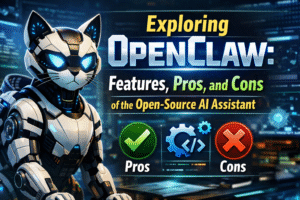
OpenClaw is an open-source AI assistant designed to operate entirely on local machines, offering a unique approach to AI interaction. In this comprehensive analysis, we delve into its features, advantages, and challenges to provide a clear understanding …
Tool Calling in AI Agents: How LLMs Execute Real-World Actions in 2026

Introduction: Why Tool Calling Is the Backbone of Modern AI Agents
Large Language Models (LLMs) are incredibly powerful at understanding and generating text. But here’s the truth — text alone isn’t enough. If an AI agent can only talk …
Harnessing LLMs and Generative AI: The Rise of Autonomous AI Agents

Understanding the Rise of AI Agents
Artificial Intelligence (AI) agents, powered by advanced algorithms and large language models (LLMs), are rapidly becoming a driving force behind innovation in fields like software development, customer service, and more. These autonomous systems perform …
Top RAG Frameworks for LLMs in 2025: Your Complete Comparison Guide

In the dynamic world of artificial intelligence, Retrieval-Augmented Generation (RAG) stands out as a revolutionary approach. By merging retrieval systems with the creative capabilities of Large Language Models (LLMs), RAG enables AI systems to deliver precise, context-aware, and scalable solutions …