The release of the open-source Model Context Protocol (MCP) by Anthropic has fundamentally solved the fragmented landscape of AI tool calling. Before MCP, connecting an LLM to your local database, developer terminal, or internal API required writing bespoke integration …
Building an Autonomous Research Agent with Python and DuckDuckGo / Tavily Search API
When building enterprise Retrieval-Augmented Generation (RAG) systems in 2026, relying purely on dense vector embeddings (like OpenAI text-embedding-3 or BGE) introduces severe blind spots. Dense vectors excel at semantic similarity—understanding that ‘laptop’ and ‘notebook computer’ mean the same thing. However, …
Local LLM Tool Calling with Ollama and Python: Step-by-Step Implementation
Running Large Language Models locally has evolved from basic chat interfaces into sophisticated autonomous systems capable of executing deterministic software tools. With modern models like Llama 3.1, Qwen 2.5, and Mistral supporting native tool calling, developers can build private, zero-token-cost …
LangGraph StateGraph Tutorial: Building Multi-Agent Workflows in Python
While simple sequential chains (like those in early LangChain) work for basic question-answering, production AI applications require loops, conditional branching, human-in-the-loop approvals, and multi-agent debate. In 2026, LangGraph has become the premier framework for developing complex, cyclic agent architectures.…
Build a Model Context Protocol (MCP) Server in Python: Complete Step-by-Step Guide
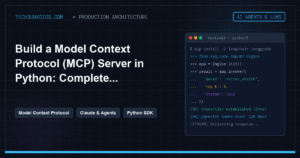
The Model Context Protocol (MCP), pioneered by Anthropic in late 2024 and adopted across the developer ecosystem in 2025 and 2026, standardizes how Large Language Models securely access local and remote data sources, developer tools, and enterprise APIs. Before MCP, …
Exploring OpenClaw: Features, Pros, and Cons of the Open-Source AI Assistant
Introduction: Unveiling OpenClaw
OpenClaw is an open-source AI assistant designed to operate entirely on local machines, offering a unique approach to AI interaction. In this comprehensive analysis, we delve into its features, advantages, and challenges to provide a clear understanding …
Tool Calling in AI Agents: How LLMs Execute Real-World Actions in 2026

Introduction: Why Tool Calling Is the Backbone of Modern AI Agents
Large Language Models (LLMs) are incredibly powerful at understanding and generating text. But here’s the truth — text alone isn’t enough. If an AI agent can only talk …
Harnessing LLMs and Generative AI: The Rise of Autonomous AI Agents

Understanding the Rise of AI Agents
Artificial Intelligence (AI) agents, powered by advanced algorithms and large language models (LLMs), are rapidly becoming a driving force behind innovation in fields like software development, customer service, and more. These autonomous systems perform …
Top RAG Frameworks for LLMs in 2025: Your Complete Comparison Guide

In the dynamic world of artificial intelligence, Retrieval-Augmented Generation (RAG) stands out as a revolutionary approach. By merging retrieval systems with the creative capabilities of Large Language Models (LLMs), RAG enables AI systems to deliver precise, context-aware, and scalable solutions …