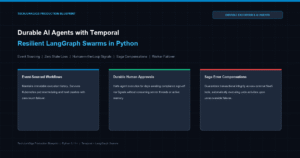
In production generative AI engineering, a painful chasm exists between laboratory agent demonstrations and mission-critical enterprise systems. In prototype environments, developers run multi-agent workflows inside standard FastAPI request loops, Celery task queues, or basic Python scripts. If an agent executes …
Prompt Caching in Python: Slashing LLM Latency and Costs with vLLM
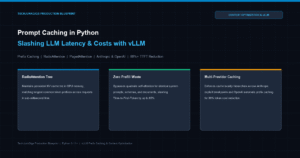
In self-hosted and API-based generative AI systems, a staggering proportion of operational expenditure and user latency is wasted on redundant computation. Whether serving multi-turn conversational agents, complex document retrieval-augmented generation (RAG), or autonomous coding workflows, between 70% and 95% of …
Speculative Decoding in Python: Accelerating LLM Inference with vLLM
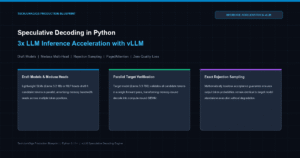
In self-hosted generative AI infrastructure, production engineering teams quickly encounter an unforgiving physical reality: large language model (LLM) inference is severely memory-bandwidth bound during token generation. While processing the initial input prompt (the prefill phase) saturates GPU tensor cores with …
Production LLM Evaluation in Python: Building Continuous CI/CD Quality Gates with DeepEval, Ragas, and LLM-as-a-Judge for Enterprise GenAI
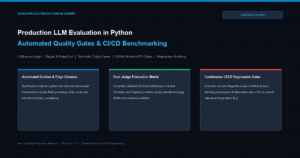
In traditional software engineering, deploying code without automated unit tests, integration tests, and continuous integration (CI/CD) pipelines is considered professional negligence. Yet in generative AI, engineering teams routinely push prompt modifications, vector database index updates, and model parameter tweaks directly …
Hierarchical Multi-Agent Supervisor Swarms in LangGraph: Building Router-Worker Systems with Redis State Persistence in Python
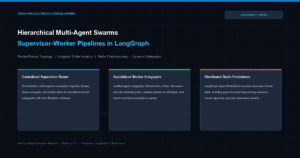
When developers first experiment with agentic AI, they almost always begin with a monolithic design: a single Large Language Model equipped with a system prompt and a flat list of fifteen to thirty tools. In simple demonstrations, this architecture appears …
Corrective RAG (CRAG) in Python with LangGraph: Building Self-Reflective Retrieval Pipelines with Document Grading, Fallback Web Search, and Hallucination Gates
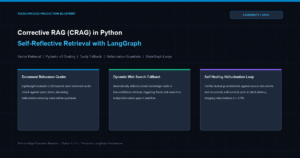
Standard Retrieval-Augmented Generation (RAG) architectures operate on an optimistic, fragile assumption: that the vector store always returns relevant, high-quality context for any user query. In production, this assumption breaks down rapidly. Vector similarity does not guarantee semantic relevance, query phrasing …
Building a Distributed Enterprise MCP Gateway in Python: Remote SSE, Bearer Authentication, Dynamic Tool Discovery, and LangGraph Swarms
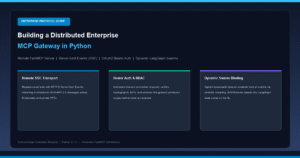
The open-source release of the Model Context Protocol (MCP) by Anthropic has fundamentally unified how artificial intelligence models interface with external software tools, databases, and enterprise APIs. By replacing brittle, bespoke tool-calling wrappers with an open, standardized protocol, MCP provides …
Fine-Tuning Small Language Models (SLMs) for Enterprise Production: Data Curation, QLoRA, Guardrails, and Governance
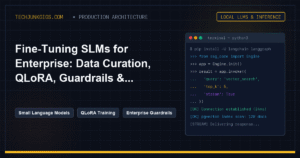
Sending every internal customer support ticket, proprietary financial ledger, medical claim, or database schema to commercial frontier LLM APIs (such as GPT-4o or Claude 3.5 Sonnet) is an architectural and financial anti-pattern.
At enterprise scale, relying exclusively on third-party public …
Scaling Test-Time Compute in Python: How Process Reward Models and MCTS Beat 14x Larger LLMs
For the last five years, the artificial intelligence industry operated under the brute-force doctrine of the Kaplan and Chinchilla pre-training scaling laws: if you want a more capable model, you simply burn more GPU hours, expand parameter counts from 7B …
Multi-Agent Consensus in LangGraph: Building Debate and Peer Review Swarms in Python
When you deploy a single large language model to make high-stakes architectural or operational decisions, you are gambling on a statistical dice roll. Even frontier reasoning models like Claude 3.5 Sonnet, GPT-4o, and DeepSeek-R1 suffer from cognitive blind spots: confirmation …
- 1
- 2
- 3
- …
- 11
- Next Page »